27. – 28. November 2025 | Royal Society of Edinburgh (RSE)
By Judith Crämer & Christoph Kleineberg
Day 1 – Moving Forward with Enthusiasm
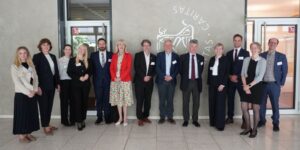
On 27 November 2025, the Lower Saxony – Scotland Joint Forum was ceremonially opened at the Royal Society of Edinburgh (RSE). Representatives from academia, politics and research institutions from Lower Saxony and Scotland came together to deepen existing partnerships and initiate new collaborations. The event was organised by the European Centre for Advanced Studies (ECAS) in cooperation with the RSE and was funded by the Lower Saxonian Ministry of Science and Culture (MWK) and the Volkswagen Foundation as part of zukunft.niedersachsen.
Under the guiding theme “Building New Partnerships”, the Joint Forum focused on knowledge exchange, international research initiatives and joint responses to global challenges. Lower Saxony’s Minister for Science and Culture, Falko Mohrs, paid tribute to the intensive exchange between universities in Lower Saxony and Scotland and announced that cooperation would be continued in 2026 with one million euros through the Lower Saxony – Scotland Research and Innovation Scheme.
The German Consul General in Edinburgh, Christiane Hullmann, emphasised: “This outstanding partnership elevates scientific cooperation between Scotland and Germany to a new level. At the same time, it makes an important contribution to German–British relations as a whole and fully reflects the spirit of the Kensington Treaty signed in July.” Prof. Dr Anne H. Anderson, Vice-President for Research at the RSE, also underlined the importance of the collaboration and chaired the event.
Panel I – Knowledge Exchange, Democracy and International Cooperation
The first panel addressed how international research partnerships can be designed sustainably. Personal encounters remain a key driver of trust, creativity and innovation, while digital formats play a supportive role. Cultural differences – for example in communication styles or response times – were perceived as enriching and served as an opportunity to reflect on one’s own working culture.
Moritz Dütemeyer (MWK) stressed that the major challenges of our time – from climate change to future pandemics – can only be addressed through international cooperation. Dr Jamie Davies (Arts and Humanities Research Council, AHRC) referred to the track record of German–Scottish cooperation since 2018 within the framework of joint calls with the German Research Foundation (DFG): of 127 funded projects, 25 were led by Scottish institutions such as Glasgow, Aberdeen, Dundee, Edinburgh or St Andrews, and 11 by universities in Lower Saxony including Göttingen, Osnabrück, Braunschweig, Lüneburg and Hanover. Davies highlighted the diversity of the collaborations. Dr Ally Hughes (Scottish Universities Life Sciences Alliance, SULSA) Dr Ally Hughes (Scottish Universities Life Sciences Alliance, SULSA) highlighted the importance of re-establishing links with international partners such as Germany to remain competitive in Horizon Europe.
ECAS Flagship Initiative – Energy as a Strategic Future Topic
Representatives of the ECAS flagship initiative Lower Saxony – Scotland Strategic Energy Partnership presented approaches to initiating new contacts and research projects. Prof. Dr Daniel Friedrich (University of Edinburgh), Alexandra Reinhild Berndt (Energy Research Centre of Lower Saxony, efzn) and Natasha Madeira (Scottish Partnership in Energy and Engineering Research & Innovation, SPEERI) emphasised the potential of cooperation in the field of the energy transition. While Lower Saxony offers strong expertise in renewable energies and energy systems, Scotland provides excellent conditions for wind energy, offshore technologies and geothermal energy. These complementary strengths create significant added value for joint projects.
Panel II – Knowledge Exchange in a Transregional Context
In the second panel, selected projects from Stream I – Development Track, funded by the RSE, were presented:
- CONNECT-WELL – Adapting Methods to Assess Social Connectedness and Well-Being Among Young Refugees
(Prof. Dr Marcia Vera Espinoza, Queen Margaret University Edinburgh, and Prof. Dr Cordula von Denkowski, Hannover University of Applied Sciences) - Parkinson’s Research – Establishing Autophagy Models of Parkinson’s Disease
(Prof. Dr Ian Ganley, University of Dundee, and Prof. Dr Franziska Richter Assencio, University of Veterinary Medicine Hannover) - Positive Animal Welfare
(Prof. Dr Cathy Dwyer, University of Edinburgh) - Hydrogen and CO₂ Trade Between Scotland and Germany
(Dr Christian Calvillo, University of Strathclyde; Dr Dirk Zapf and Dr Astrid Bensmann, Leibniz University Hannover)
The projects demonstrated how targeted funding enables rapid collaboration and tangible results, as illustrated by the joint Parkinson’s research: a method developed in Scotland was, for the first time, tested on a specific genetic mouse line in Lower Saxony – a collaboration that would not have been possible without the programme. Further discussions addressed CO₂ storage, animal welfare and interdisciplinary approaches to climate research. The diversity of the projects highlighted the innovative strength of the Lower Saxony–Scottish research landscape.
Evening Reception
ECAS Academic Directors Prof. Dr James Conroy and Prof. Dr Markus Reihlen emphasised the strong bonds of friendship that have developed between Lower Saxony and Scotland. A reception including a guided tour of the RSE provided opportunities for networking, in-depth discussions and the development of new project ideas.
Day 2 – From Idea to Implementation
The second day focused on practical collaboration and project development. Interactive workshops enabled participants to further develop ideas and initiate new partnerships.
Dr Lauren Douglas (RSE) and Dr Harald Barre (Volkswagen Foundation) provided an overview of the Research and Innovation Scheme, which specifically supports researchers in preparing Horizon Europe applications and other funding formats, as well as facilitating project initiation. Dr Barre noted: “The Joint Forum offers an exceptional opportunity to experience the power of bright minds with great ideas that transcend borders and merge into excellent collaborative projects.”
Existing collaborations may apply under the current call of Stream II – Excellence Track until the end of April 2026. Further information events are planned for January and February 2026.
The workshops covered a wide range of topics, including opportunities and challenges for clinical scientists, ethical and intercultural aspects of artificial intelligence, strategies for heating and cooling transitions through cross-border subsurface thermal storage, virology and pandemic preparedness, social justice, intercultural communication, sustainability, and responsibility in global supply chains, incorporating concepts from the Global South.
Conclusion & Outlook
Prof. Dr Anne H. Anderson concluded by summarising the forum’s impressions and highlighting the importance of long-term, resilient collaborations: “The Joint Forum impressively demonstrates how valuable personal exchange is for scientific excellence and sustainable innovation – particularly in the European context after Brexit.” It was far more than a conference: it was a clear commitment to international cooperation, mutual trust and the conviction that the major challenges of our time can only be solved together.
 Previous